Felix gonzales torres
.jpeg)
Félix González-Torres (1957–1996), born in Cuba and later based in the United States, was one of the most significant conceptual artists of the 1990s. His works were often extremely minimalist: light bulbs, wires, clocks, sweets, paper… all the most ordinary, everyday materials.
His creative period coincided with the height of the AIDS crisis in the United States. In 1991, his partner Ross Laycock died of AIDS-related complications, and González-Torres himself passed away from AIDS in 1996. Many of his works are closely linked to this experience.
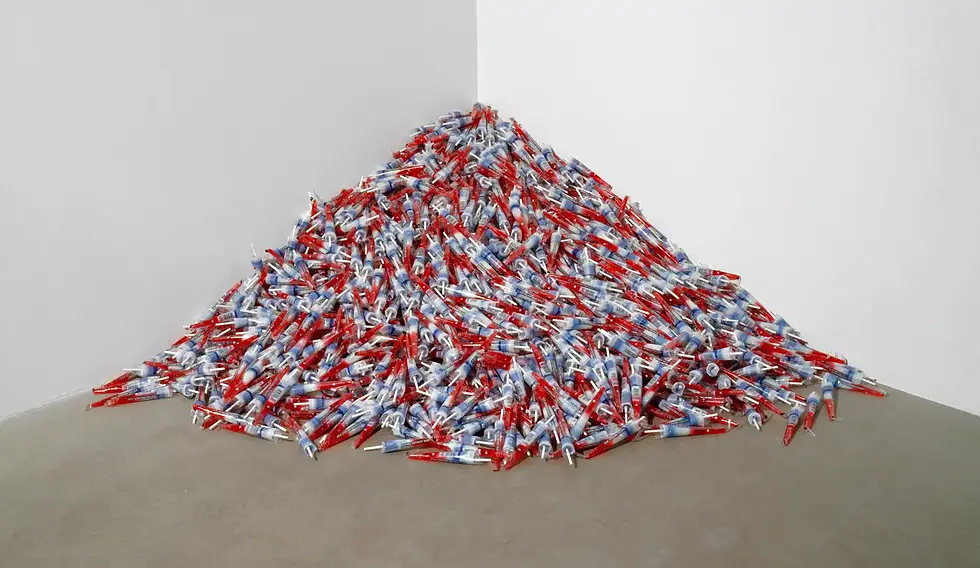
*Untitled (Portrait of Ross in L.A.)*
Created in 1991.
On the surface, the work appears extremely simple: a pile of beautifully wrapped sweets placed in a corner of the gallery, which visitors are free to take and eat.
The pile of sweets represents the body of his partner, Ross. He rejected grand narratives of death.
As visitors continually take the sweets, the pile grows smaller, becomes lighter in weight, and gradually shrinks in volume.
This corresponds to the process of physical wasting experienced by people living with AIDS. Ross experienced significant weight loss after contracting the disease, and the act of the audience physically taking the sweets effectively makes them participants in this ‘disappearance’.
This work expresses the artist’s personal emotions whilst also being closely linked to the AIDS crisis and the social neglect suffered by the gay community.
When creating *Who Killed the Plastic Chair?*, I also drew upon this creative strategy of transforming everyday objects into vessels for human experience.
.jpg)
.jpg)